The Nürburgring is a place where roaring sports cars, featherweight track specials, and prototype hypercars sharpen their edges. A full‑size luxury sedan lapping the Green Hell, however, still raises eyebrows. In early 2026, the very sight of a heavily camouflaged BMW 7 Series prototype tackling the iconic circuit challenged expectations. The big four‑door seemed far more at ease on an unrestricted autobahn than clipping apexes, yet the choice of venue spoke volumes—BMW is serious about infusing its flagship with new dynamic energy.
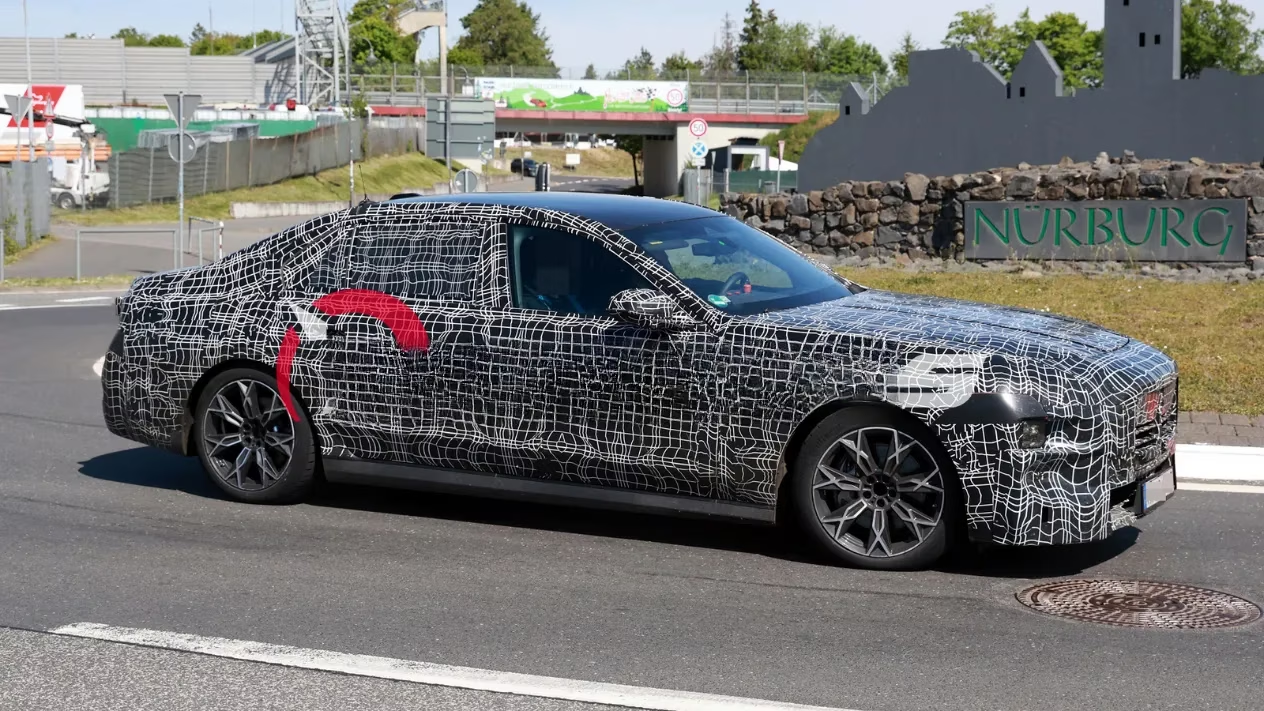
The spy shots instantly ignited a flurry of questions. Why bring the 7 Series to the Nordschleife at this stage of its lifecycle? Could BMW be hiding something more than a routine cosmetic update? The test mule, wrapped in bewildering black‑and‑white foil from nose to tail, confirmed that a mid‑cycle refresh—what the Bavarians term a “Life Cycle Impulse”—is well underway. Notably, there was no “E” number plate or visible charging flap, signalling that the test car is likely a conventional petrol or diesel variant, while the all‑electric i7 is being developed in parallel.
Exterior evolution: tradition meets controversy
The side profile of the 2026 7 Series prototype reveals almost no change. Facelifts rarely tamper with a car’s silhouette, and BMW’s designers have wisely left the sweeping roofline and balanced proportions intact. Instead, the transformation concentrates on the front and rear ends. At the front, temporary light units mask the production intent, but their low placement strongly hints at the survival of the split‑headlight design—a styling cue that has divided opinion since the current G70 generation debuted. Could BMW really be persisting with this polarizing arrangement? If the test car is any guide, the answer is yes. The absence of conventional daytime running lights in the upper cluster only reinforces the suspicion: the slim LED eyebrows above and the main beams below are here to stay.
Flanking the colossal kidney grilles—which, as expected, refuse to shrink—the nose will likely receive refined detailing rather than a full redesign. The grilles themselves continue to dominate, a statement of presence that BMW sees as essential to the 7 Series’ identity. Whether enthusiasts will warm to it is another matter, but the message from Munich is clear: evolution, not revolution.
Turning to the rear, the camouflage conceals nearly everything. Outlines, shapes, even the inner graphics of the taillights remain a mystery. Yet the bulky wrap hints at a wider, more horizontal light signature beneath. Spies have noted that the current model’s slim LED strip might give way to a broader panel that connects the two clusters, visually lowering the car and emphasising its width. Such a change would fall in line with BMW’s current design language seen on the X5 and X6 facelifts. What lies underneath? Only time will tell, but the rear end appears poised to gain a more modern, integrated look without abandoning the upright, formal stance that luxury saloon buyers appreciate.
A cabin ready for a quantum leap
If the exterior tweaks are evolutionary, the interior is set for a dramatic step forward. Earlier spy photos of the updated 7 Series revealed the heart of the revolution: BMW’s next‑generation infotainment system, called iDrive X. At its centre sits a massive 17.9‑inch curved display, angled towards the driver and expected to run the latest iteration of BMW Operating System. Alongside it, perhaps the most futuristic addition is the “Panoramic Vision” projection system. Stretched across the base of the windscreen, it transforms the entire lower glass area into a digital ribbon.
How will it work in everyday driving? The Panoramic Vision screen is divided into nine configurable tiles: three fixed ones dedicated to critical driving data such as speed and navigation prompts, and six others that the driver or passenger can tailor to their preferences—music, climate, efficiency graphs, or even a video feed from the car’s cameras. This setup aims to reduce the need to glance away from the road, placing key information directly in the driver’s line of sight. Combined with the central touchscreen, an augmented‑reality head‑up display, and the signature rotary controller that has been subtly redesigned, the new 7 Series cockpit will feel like a spaceship compared to the already tech‑laden current model. Could this mark the end of the classic button‑heavy BMW interior? It certainly seems that way, as physical controls are being streamlined to create a cleaner, more digital environment.
Timing and the Alpina electrification promise
BMW has not officially announced the reveal date for the refreshed 7 Series, but supplier circles indicate that series production is scheduled to start by mid‑2026. That would place a world premiere within the next few months, possibly at one of the major auto shows later this year. Given the usual ramp‑up timeline, early customers could take delivery before the end of 2026.
Intriguingly, the Life Cycle Impulse won’t be limited to the core BMW range. Recent reports have confirmed that once the updated 7 Series and i7 settle into production, BMW will roll out three Alpina variants. One of these will be based on the all‑electric i7, marking Alpina’s first ever battery‑electric vehicle. While Alpina has traditionally honed combustion‑engined BMWs into sublime grand tourers, the move into an electric 7 Series signals a new chapter. The electric Alpina i7 is expected to blend the firm’s renowned ride comfort and bespoke interior appointments with the instantaneous torque of an EV powertrain, creating a unique luxury express. For a brand that has always stayed close to BMW while carving its own path, this electrified future feels both surprising and inevitable.
The road ahead
The 2026 7 Series facelift promises to be more than a simple cosmetic update. By choosing the Nürburgring as a testing ground, BMW is hinting at sharper dynamics even for its largest sedan. The retention of the split headlight design shows confidence in a bold aesthetic direction, while the Panasonic‑scale central display and Panoramic Vision projection underscore a technology transformation that reaches beyond any mid‑cycle refresh in recent memory. And with an electric Alpina on the horizon, the 7 Series family is set to stretch from traditional V8 luxury to silent, zero‑emission opulence. For those who thought a facelift meant little more than new bumpers, the 2026 BMW 7 Series is about to rewrite the rulebook.