Picture this: It’s 2026, and I’m sweeping down an unrestricted Autobahn in a car that, to the uninitiated, looks like a Passat that hit the gym and got a middle-management promotion. But under my right foot lies a hand‑built 6.0‑liter W12—the same jewel of an engine that also nestles between the wings of Bentleys. The cabin is quieter than a Tibetan monastery, the ride as buttery as a diplomat’s handshake, and I am overtaking Porsches with nothing but a muted whoosh. This is the Volkswagen Phaeton W12, the most preposterous, over‑engineered sleeper ever to grace the tarmac. I’m still grinning like a man who just discovered a Picasso at a garage sale. How in the name of Zuffenhausen did this happen? Who greenlit a limousine that wears a VW roundel yet packs more tech than a space station? Strap in, because we’re about to deep‑dive into the lunatic fringe of automotive history.
The Mad Scientist Behind the W12
Let’s rewind to the late 1990s. Ferdinand Piëch, the visionary (and borderline obsessive) chairman of Volkswagen, was about to retire, but he wasn’t going quietly. He’d already resurrected the Beetle and made Audi a genuine threat to Mercedes. Now he wanted to thrust humble Volkswagen into the super‑luxury ring—the playground of the S‑Class, 7 Series, and A8. It was like a local baker deciding to challenge a three‑Michelin‑star patisserie. Piëch’s answer? The Concept D at the 1999 Frankfurt show, a sleek hatch‑backed sedan with a V10 TDI that screamed “I’m coming for your throne.” Two years later, the production Phaeton arrived, initially with a mere V6. But Piëch had a secret weapon: a 6.0‑liter W12 that would make the establishment choke on their champagne.
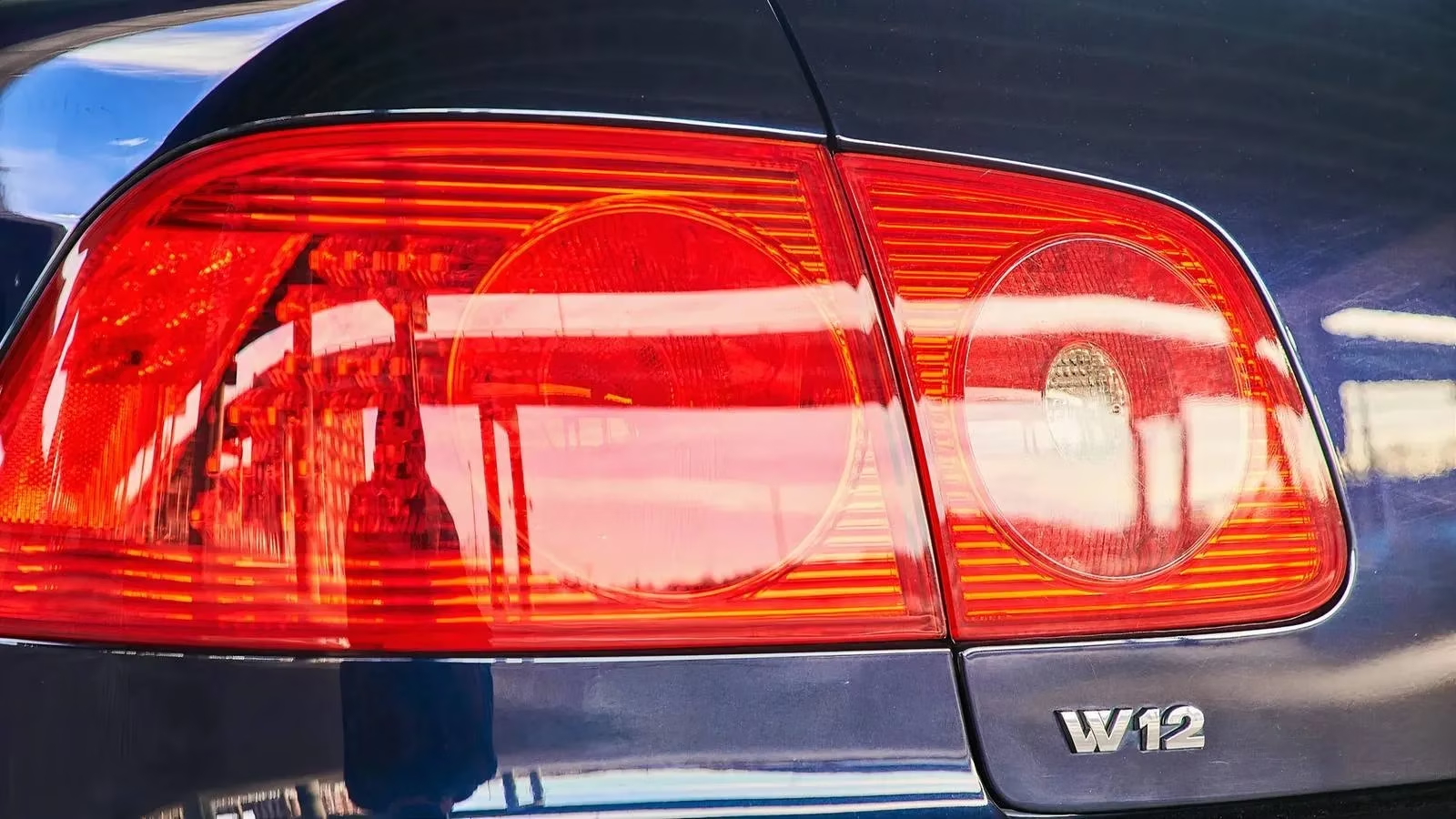
Why a W12, you ask? Because Piëch reasoned that if you’re going to crash the party, you damn well better bring the most exotic engine layout short of a Bugatti. The W12 is essentially two narrow‑angle VR6 engines fused at a 72‑degree angle on a common crankcase, creating an engine so short it could fit transversely in a Golf. In the Phaeton, it sat longitudinally, pumping out 420 horsepower and a tidal wave of torque. This wasn’t just any motor—Volkswagen was quick to point out it shared its soul with Bentleys and the Audi A8 W12. That’s like discovering your quiet neighbor has a supermodel twin. Suddenly, the Phaeton’s price tag of $91,415 in 2004 felt less insane, and more like a steal for a hand‑built, 12‑cylinder masterpiece.
A Climate Control System from Another Planet
Volkswagen’s engineering mania didn’t stop at the powertrain. The Phaeton rode on advanced air suspension that smothered potholes like a grandmother’s hug. The interior was slathered in leather, wood, and metal worthy of a royal yacht. But the real mic drop was the four‑zone automatic climate control. Piëch’s engineers proudly declared that the system could maintain a steady 22°C (72°F) inside the cabin while the outside air baked at a hellish 50°C (122°F), all day long, at a constant 186 mph. Yes, you read that right. They designed the air conditioning to work flawlessly at nearly 300 km/h. Did any owner ever need to exploit this capability? Probably not, unless they were fleeing a volcano while late for an opera. But the fact that VW even thought of it is deliciously absurd. And let’s not forget the windscreen wipers, engineered to clear rain at speeds beyond 155 mph. The whole car was a rolling “because we can” statement.
Why Did It Flop? (And Why I’m Grateful)
Now for the billion‑dollar question: Why didn’t the Phaeton conquer America? The answer stings like a rejection letter from a country club. VW’s own post‑mortem admitted the car failed to win over “a status‑sensitive American audience.” In a market where the three‑pointed star or the blue‑and‑white propeller shouted success, a VW badge felt like wearing a polyester suit to a black‑tie gala. Luxury buyers simply couldn’t stomach spending S‑Class money on something that shared its badge with a Jetta. Sales were so slow that VW pulled the Phaeton from the US after just three model years. Globally, it fared better—especially in China, where understated wealth is an art form—but in the States, it became a cult curiosity.
And you know what? I’m ecstatic about that failure. Why? Because now, in 2026, the Phaeton W12 is the automotive bargain of the century. According to Classic.com, average used prices for the whole Phaeton range hover around $14,151 for 2004 models, and an even more absurd $13,665 for 2006 examples. Good W12 cars now trade for $15,000 to $20,000, with rough runners dipping below $10,000. Yes, you can own a hand‑assembled, 420‑hp, velvet‑wrapped missile for less than a used Honda Civic. The depreciation curve is steeper than a cliff face, and I am here for it. Maintenance? Sure, a W12 won’t be as cheap to fix as a Toyota, but when you’re buying a six‑figure luxury sedan for the price of a latte addiction, you’ve got plenty of headroom for the occasional eye‑watering repair bill.
The Bentley Twin You Forgot About
Here’s where the story gets even juicier. Remember the Bentley Continental GT that launched in 2003 and immediately became the chariot of Premier League footballers and Monaco playboys? That was a Volkswagen Group machine, too. And when Bentley needed a super‑sedan, it took the Phaeton’s platform, draped it in Crewe leather, bolted on twin turbos to the same 6.0‑liter W12, and called it the Continental Flying Spur. In 2006, that Flying Spur cost a staggering $171,285—nearly double the Phaeton’s MSRP. For that money, you got 552 horsepower, a 0‑60 mph time of 4.6 seconds, and a top speed of 195 mph that flirted with aerodynamic insanity. Today, Hagerty says a good 2006 Flying Spur will set you back around $30,500. That’s still a monumental deal, but the Phaeton offers 80% of the Bentley experience for half the price, or less. It’s the stealth wealth advocate’s dream.
| Specification | 2004 VW Phaeton W12 | 2006 Bentley Continental Flying Spur |
|---|---|---|
| Engine | 6.0L W12, 420 hp | Twin‑turbo 6.0L W12, 552 hp |
| 0–60 mph | 5.5 seconds | 4.6 seconds |
| Top Speed | 155 mph (limited) | 195 mph |
| Original Price | ~$91,415 | ~$171,285 |
| Used Price (2026) | $13,000–$20,000 | ~$30,500 |
The Ultimate Q‑Ship for 2026
You want to know why I’m obsessed? Because the Phaeton W12 is the perfect automotive paradox. It’s a car that can do 201 mph (as Jeremy Clarkson famously proved), yet it disappears in a parking lot. It has the engineering depth of a spaceship, yet it’s priced like a family sedan. It’s the four‑door that confuses valets and delights the initiated. Every drive feels like a secret handshake with genius. And in 2026, with the world going electric and V12s vanishing into history, snagging one of these feels like a moral duty. The only question left is: can you handle the constant, smug grin it will plaster on your face? I dare you to find out.