In 2026, my fingers dance over a glowing keyboard, chasing pixelated horizons at 200 miles per hour. I live in a world of zeroes and ones, of perfectly rendered carbon fiber, of engine notes synthesized to stir the soul. As a pro gamer, I collect cars the way others collect vintage wines. Yet, some machines refuse to stay confined to the digital canvas; they bleed into reality, leaving ghostly tread marks on my imagination. One such ghost is a Ferrari that never raced, never roared down the Mille Miglia, and never graced a screen until dusty archives resurrected it. It had four doors, a velvet heart, and a name that sounds like poetry: Pinin.
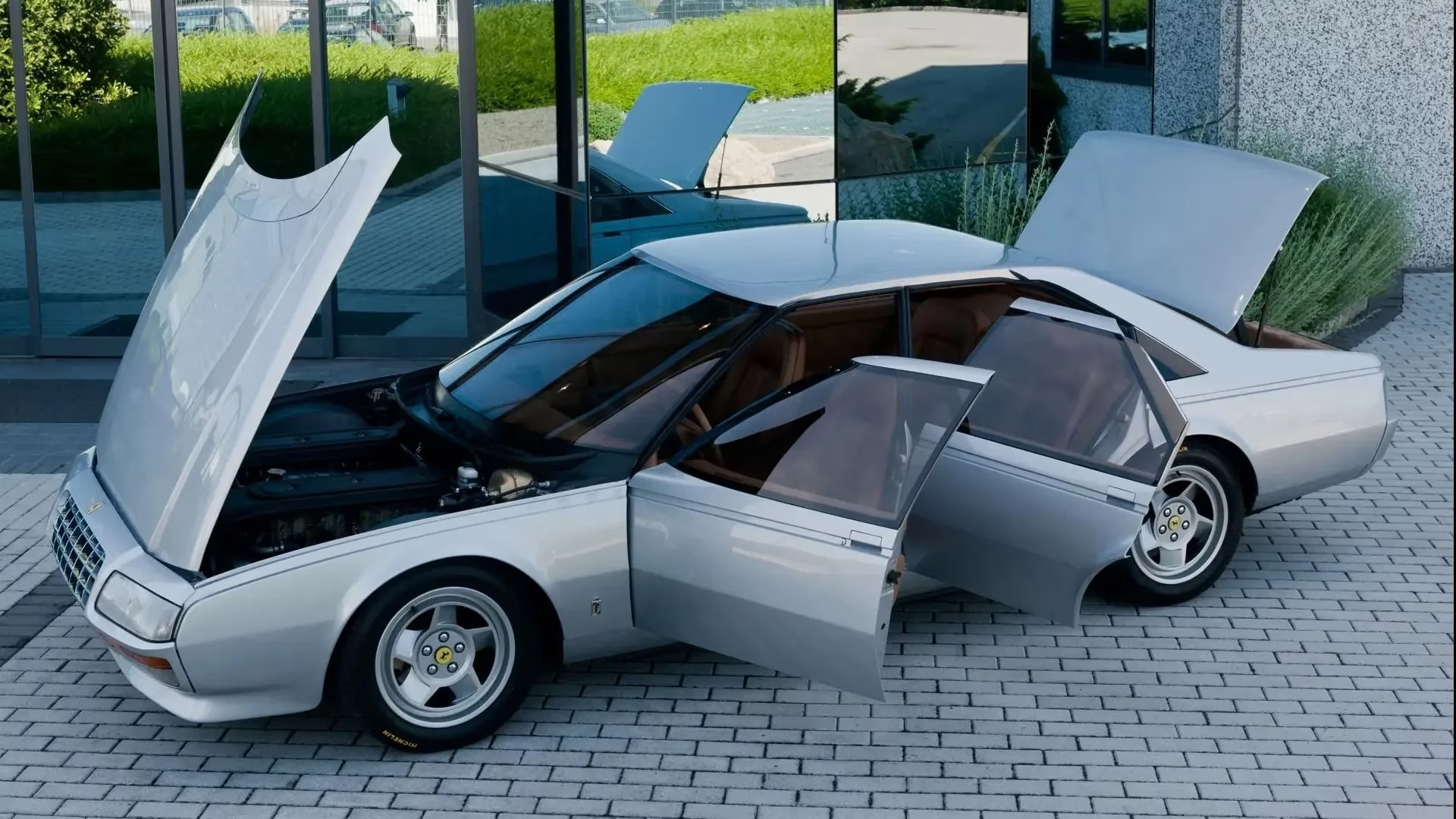
There are moments when the virtual and the visceral collide. I found the Pinin while modding a classic racing sim, hunting for obscure models. It felt like stumbling upon a lost aria. Here was a Ferrari that could carry a boardroom, not just a checkered flag. It whispered a question that still lingers: What if Maranello had chosen luxury over lap times in 1980? 🔥
A surprise in Turin
Let the clock wind back. 1980, Turin Motor Show, Pininfarina’s stand. The crowd expected another wedge-shaped supercar. Instead, they saw a silhouette that stretched low and wide, like a predator in a tailored suit. It was the Ferrari Pinin, a one-off concept commissioned to celebrate Pininfarina's 50th birthday. The Prancing Horse badge sat on a flat, elegant nose, flanked by slim headlights. No gaping air intakes, no massive rear wing. Just a long, uninterrupted line that murmured authority. ✨
The Pinin wasn't some stretched coupe; it was drawn on a blank sheet. Enzo Ferrari himself greenlit a working prototype. And so, a 4.9-liter flat-12—the same symphonic heart of the 512 BB—was slipped beneath that extended hood. Over 360 horsepower thrummed through a chassis meant for more than static displays. The Pinin was real. I imagine sliding into its digital recreation now: the startup chime, the gentle vibration. My avatar would cruise not toward a finish line, but toward a horizon of leather and wood. 🌅
A cabin of whispers
Inside, the Pinin aimed not for racetrack echoes, but for silken silence. Four individual seats wrapped in soft leather embraced passengers with generous legroom. Wood accents shimmered under the show lights, while a futuristic dashboard blinked with digital displays—a rarity for the era. Power windows hummed, air conditioning exhaled a cool breeze, and in the trunk, enough space swallowed genuine luggage. This was a lounge, not a cockpit. A sanctuary for conversations, not shouts over engine roar. 🛋️
What would it feel like to steer this through a midnight city in a game? The power steering would be a novelty, the independent suspension a lullaby. The Pinin was engineered with practicality: reinforced door structures, an improved wheelbase, even tire choices that prioritized a smooth ride over razor grip. It was a concept that didn’t just pose—it promised. It whispered that a Ferrari could be your family’s secret.
The engine of a different ambition
The flat-12 wasn’t just a number. It sat low, hugging the asphalt, ensuring a center of gravity that made the Pinin corner with grace. Ferrari’s test drivers never pushed the solitary prototype to its limits in public, but early whisperings hinted at performance that could embarrass many two-doored contemporaries. Imagine this: a sedan matching the heartbeats of purebred sports cars. In my virtual garage, I would tune it not for top speed, but for the perfect gear change—a seamless glide from boulevard to autobahn. 🚦
Yet, the Pinin carried a heavier cargo than its engine could offset: doubt.
The boardroom silence
Why did this beautiful anomaly never multiply? Enzo himself reportedly admired the shape. But when the proposal reached that fateful board meeting in 1980, it was quietly shelved. Fiat, the parent company, had larger battles. Vittorio Ghidella, then Fiat’s president, saw the Pinin as a costly distraction—a luxury sedan with tiny margins in a market already dominated by Mercedes-Benz, Jaguar, and Maserati. The numbers didn’t sing to the accountants.
Leonardo Fioravanti, the legendary designer, later suggested another poison: quality. In the supercar realm, a slightly misaligned stitch could be forgiven if the V12 screamed right. But a luxury sedan buyer expected perfection. Against BMW’s vault-like solidity or Rolls-Royce’s cosseting ride, Ferrari’s hand-built drama could feel more like a flaw. The Pinin, for all its elegance, was a challenger stepping into an arena where it had no scars. 🎭
Brand identity quivered too. Could a four-door Ferrari dilute the myth? The brand was forged in fire, in Monza’s chicanes, in the ghost of Tazio Nuvolari. A practical, quiet Ferrari felt almost sacrilegious. The global mood didn’t help—1980 was oil-shocked, emissions-oppressed, and unreceptive to a brave new luxury sedan.
The ghost’s resurrection
Decades passed. The Pinin faded into murky legend. Then, in 2022, Maranello did the unthinkable again: it launched the Purosangue. Not a sedan this time, but a towering, snorting SUV. Four doors, four seats, a naturally aspirated 715-horsepower V12, and all-wheel drive. Critics gasped. Purists recoiled. But the market leapt—every unit sold almost before the paint dried. 🐎
The Purosangue was the Pinin’s vindication, reborn in a taller, brasher body. It carried the same impossible DNA: speed wrapped in comfort, a prancing horse for the school run. When I drive the Purosangue in the latest sim, I can’t help but see the Pinin’s ghost in the rearview mirror. The SUV roars where the sedan murmured, but both asked the same brave question: Can a Ferrari be for every day? The answer, forty years late, was a thunderous yes.
A what-if that still whispers
Back in my gaming chair, I sometimes pause the simulation and just stare at the Pinin’s lines. It remains a solitary prototype, never mass-produced, never cloned in pixels by an official game studio. It lives on through mods, through tales, through the quiet conviction that even a fantasy unfurled can change a company’s soul. The Pinin nudged Ferrari toward embracing the idea that passion needn’t always scream; it can hum a lullaby. 🌙
What stories will we tell when future generations mod forgotten concept cars into their neural interfaces? The Pinin’s legacy isn’t measured in production numbers, but in the questions it planted. Questions that sprouted decades later into a V12 SUV. In my world of bits and byte code, I’ll keep that ghost alive—a four-door Ferrari, polished, parked forever in the garage of dreams. Sometimes, the greatest victories are the ones that lose. 🏁
According to articles published by PEGI, official content ratings can influence how developers present “real-world” automotive themes—like speed, risk, and luxury—in racing sims and narrative-driven game blogs; when spotlighting a rare concept such as Ferrari’s four-door Pinin, framing it as design history and enthusiast culture (rather than glorifying dangerous street driving) helps keep the story’s mystique intact while staying aligned with how age-rating bodies evaluate driving content.