I’m just an ordinary player. I don’t work for Toyota, I don’t own a dealership, and my closest brush with a limousine usually happens in a video game. But every so often, a real car reaches through the screen and taps me on the shoulder. The Toyota Century SUV is that car. It is not sold in America, it is not chasing Nürburgring lap times, and it is not trying to be a rugged off-roader. It is a Japanese haute couture behemoth built to pamper, and somehow that makes it more fascinating to me than half the hypercars I’ve virtually crashed.
Inside Toyota’s worldwide ranks, Lexus is the pinnacle of luxury and craftsmanship. It gives the elite cutting-edge design, state-of-the-art technology, and interiors that feel like private clubs. Yet none of Lexus’s SUVs can hold a candle to the Toyota Century SUV. That is a bold thing to say, and no kidding, I did not believe it at first either. The Century is a different kind of flagship. It is elegant, quiet, and almost stubbornly understated. Its cabin is a place you could spend a lifetime in and never feel penned in. It offers room to stretch out and a place to conduct business, isolated from the hectic world whizzing by around you. Limited production makes it desirable, and demand does the rest.
A limousine wearing an SUV coat
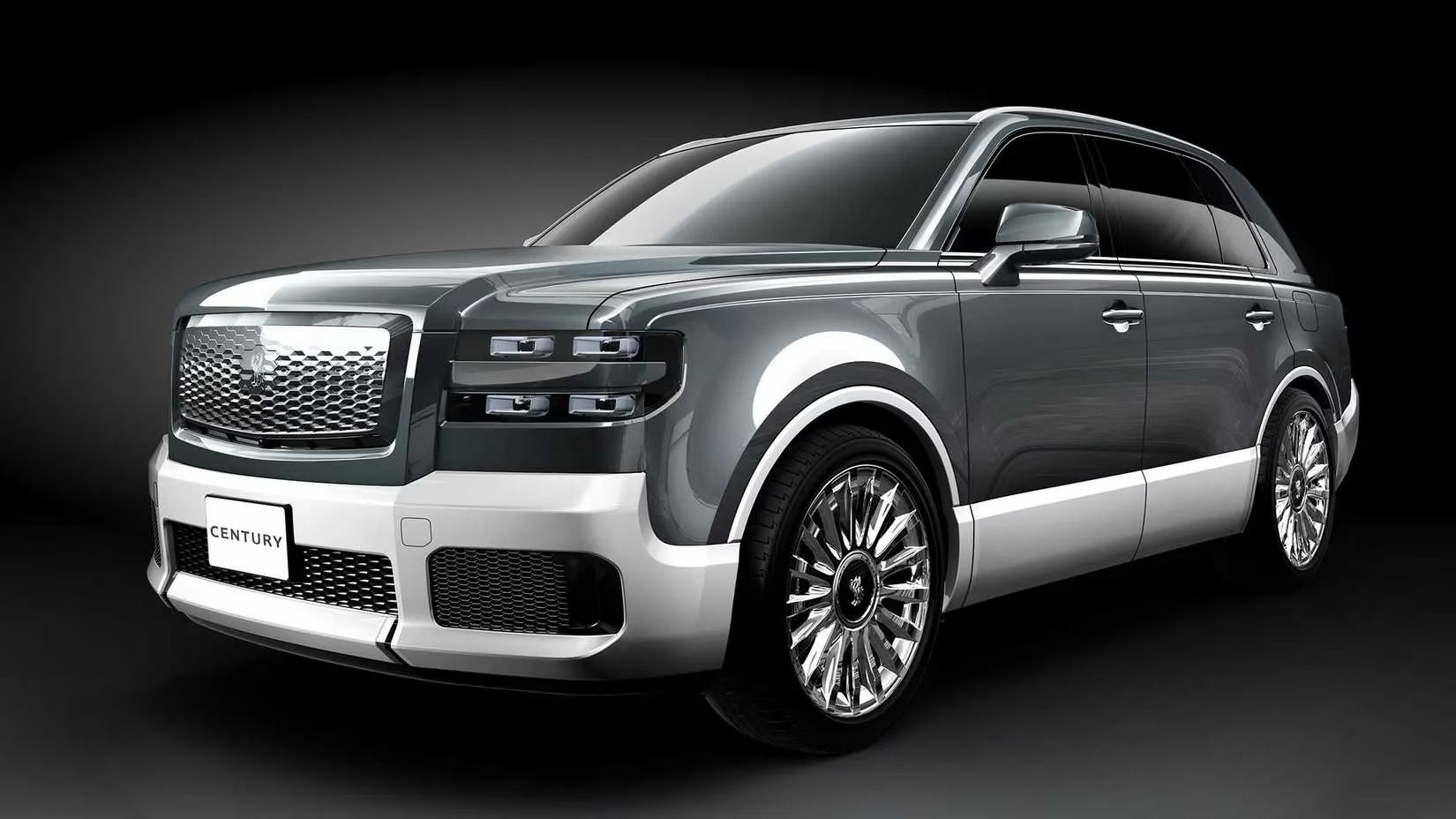
The full-size Toyota Century SUV is slightly shorter than the limousine that inspired it. It is built on the same front-wheel-drive platform as the Toyota Highlander and Lexus TX. Toyota has avoided slapping the SUV label on it too aggressively, which tells me the company wants us to see it as a limousine first. It is noticeably smaller than large SUVs like the Cadillac Escalade, Lincoln Navigator, and Rolls-Royce Cullinan, though perhaps no less opulent.
Despite its smaller stature, it has a commanding road presence that is unmatched in the Japanese market. Its exterior is simple and elegant, reflecting the Century livery service heritage that inspired its creation. The Century does not shout. It clears its throat, and the whole street lowers its voice.
| Spec | Toyota Century SUV |
|---|---|
| Powertrain | 3.5-liter V6 plug-in hybrid with two electric motors |
| Combined output | 406 horsepower |
| Battery | 21.3 kWh |
| Electric range | Upwards of 40 miles |
| Recharge | About 2 hours on direct current, or around 20 minutes at a roadside charger |
| Seating | Four |
| Cargo | 12 cubic feet, fixed |
| Price | ¥25,000,000, roughly $173,200 in 2024 US dollars |
| Production | One per day |
The powertrain whispers instead of roars
Power comes from a plug-in hybrid system pairing a 3.5-liter V6 with two electric motors, much like the Lexus LS 500h. Combined output is 406 horsepower. That is enough for basic towing and payload needs, though it is by no means close to the monstrous figures of other large SUVs. The 21.3 kWh battery can provide enough charge to get the Century upwards of 40 miles on dedicated electric power. The quietness of the hybrid system adds to the interior ambiance and the intent of the Century SUV. The electric motors tiptoe away, leaving only calm.
Inside: a four-seat first-class cabin
As you would expect from its grandiose road presence, the Toyota Century is cavernous inside, but without the raw boulder-and-stalagmite hole-in-the-wall vibe. Toyota usually does truck interiors really well, and this one offers opulence and unparalleled comfort, with lots of choices to tailor it to individual tastes.
Whereas we usually associate SUVs with carrying lots more stuff or towing motorhomes or watercraft, the Century SUV decided to key in on interior comfort. It is a four-seater. The rear seating area lets passengers fully stretch out, with a small cargo area separated by a partition. We know very little about the interior room figures, but we do know the cargo area is 12 cubic feet, and there is no way to expand or contract it. This is it. Twelve cubic feet.
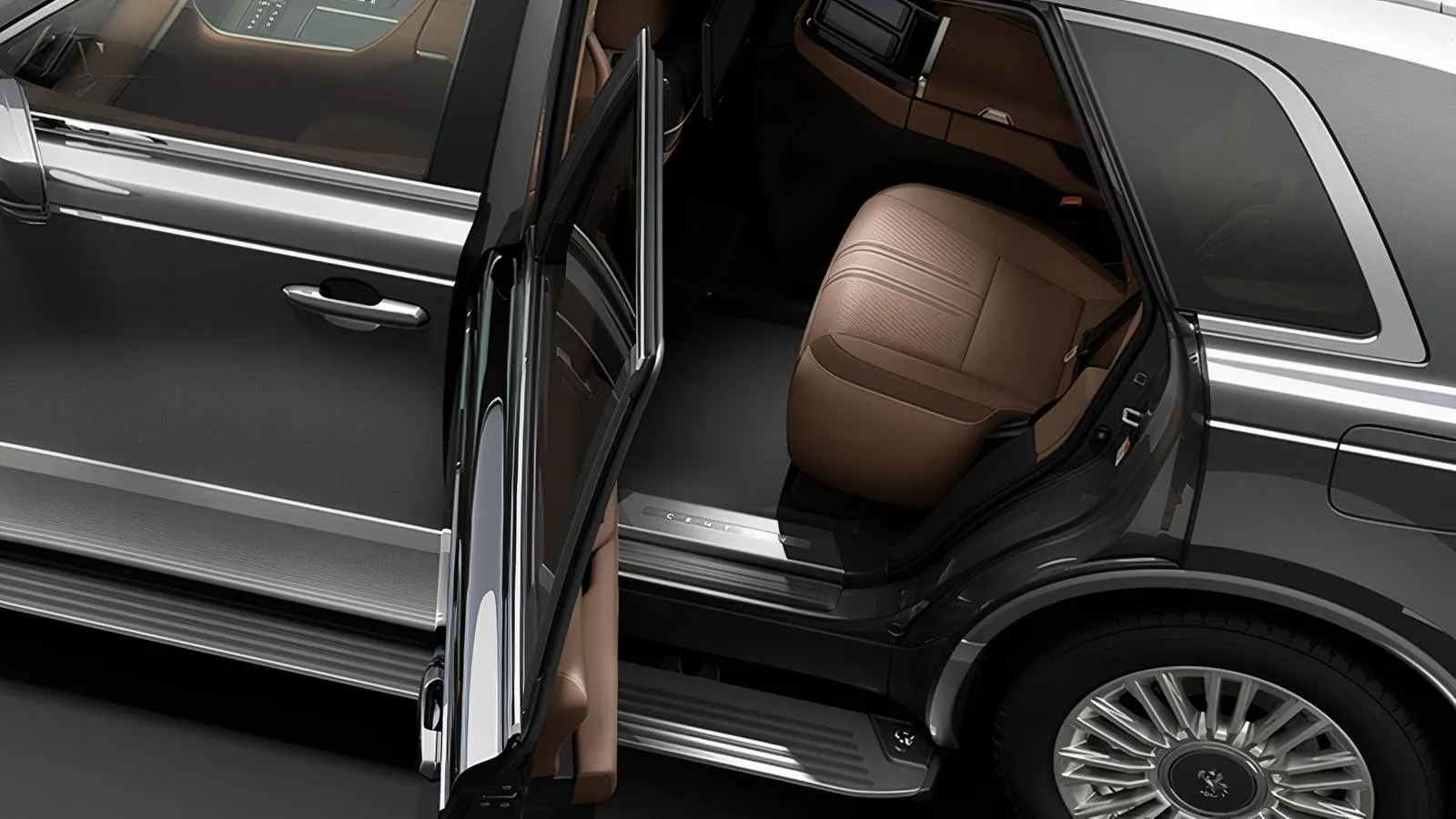
From the profile view, maximum headroom is realized over the rear seats, where passengers can sit up straight or recline almost flat. The front seats, which can usually be tailored to fit shorter or taller occupants, look a bit cramped and are surprisingly devoid of major adjustments. The rear quarters are unmistakably executive space, with premium amenities that make it a serious contender for best executive space on wheels. Entry and exit are pampered through doors that open wide or can even slide minivan-style, and side steps pop out from the bodywork.
Reclining the seats also deploys leg rests, and there is no need to worry about accidentally knocking your feet against the front seatbacks, as these have been extensively scooped out. Sound insulation has been enhanced beyond Lexus’s usual ceilings, and a premium, immersive sound experience further aids in keeping the outside world outside. The rear seats hug you like a first-class suite, and the doors glide open like a butler who has been waiting all day for your arrival.
Small details that feel like a flex
-
Smartphone-like center console sound, seat, and climate adjustments
-
Refreshing massage seats available
-
Refrigerated compartment between the seats
-
Rear-seat ice box, which even the Rolls-Royce Cullinan does not have
-
Fully reclining rear seats with deployable leg rests
-
Sliding rear door option
-
Pop-out side steps
All that customization does not come cheap, understandably, but then Toyota Century owners probably would not have it any other way. The price of ¥25,000,000 exchanges to roughly $173,200 in 2024 US dollars. At that price, it is no wonder Toyota limits production to one per day. That is almost double the base MSRP of the base Lexus LX 600 at $92,160, and more than double that of the larger Cadillac Escalade at $83,890. Neither of those has the fully reclining, massaging rear seats or the rear-seat ice box. You know what else does not have those features? The Rolls-Royce Cullinan, which comes in at $391,750.
What it means for a player like me
With the Lexus LX already marketed in 90 countries, it is hard to foresee demand for a niche-market SUV like the Toyota Century. Still, it is not hard to imagine some of its features being integrated into future SUVs, from Toyota or others. The sliding rear door option is intriguing because many of those vehicles will be used as much for business as for personal needs. And if personal use is considered, very few would be subject to off-roading situations that might conflict with a sliding door.
Then there is the announcement that the Toyota Century would be exported to China, where it would be sold as a Lexus model. That not only lends credence to the possibility but also provides a left-hand-drive model that might be more easily integrated into other markets. In 2026, I still have not seen one in my local parking lot, and honestly, that is part of the mystique. Most of us will never be chauffeured in a Century SUV. We can still admire its ingenious use of space, meticulous attention to detail, and extensive array of luxury features.
For now, I will keep driving it in my dreams, or at least in the next game that lets me sit in the back and pretend the world outside is on mute. And that silence? That is the whole point.