In a world craving both altitude and attitude, the Jeep Wagoneer Super arrived draped in chrome, its 420-horsepower heart beating to a twin-turbocharged inline-six hymn. It promised luxury with a rugged handshake. Yet, like a summer fireworks display fading against a galaxy of constellations, the Wagoneer Super meets a sky already lit by machines that redefine excess. From electric whispers to supercharged roars, the landscape of supreme sport utility vehicles has expanded into a garden of improbable blooms—each petal engineered to outshine the last.
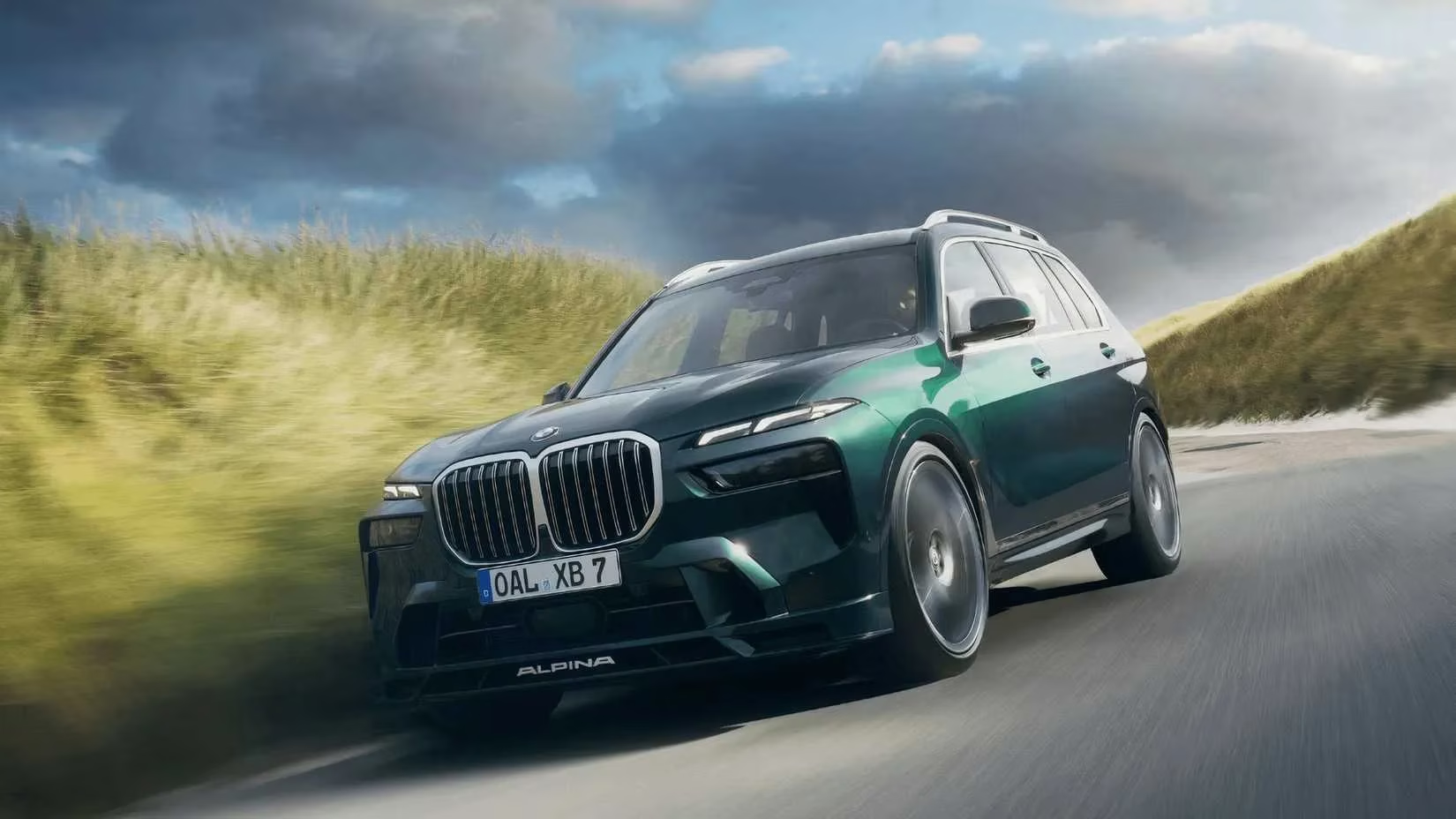
To merely call these vehicles “competitors” is to call a watchmaker an artist. The Alpina XB7, for instance, emerges from a meticulous atelier as a storm cloaked in leather. Based on the BMW X7, it inhales deeply through a 4.4-liter twin-turbocharged V8 tuned to spit out 613 horsepower—nearly a hundred horses more than its M-branded siblings. The sprint to 62 miles per hour evaporates in 4.2 seconds, a moment so brief it resembles a thought half-formed before vanishing. Its ZF eight-speed transmission orchestrates the thrust like a master conductor who has memorized every instrument’s whisper. While the XB7’s exterior may not seduce every eye, it wears its rarity like a secret handshake among enthusiasts, a silent poem for those who value substance over silhouette.
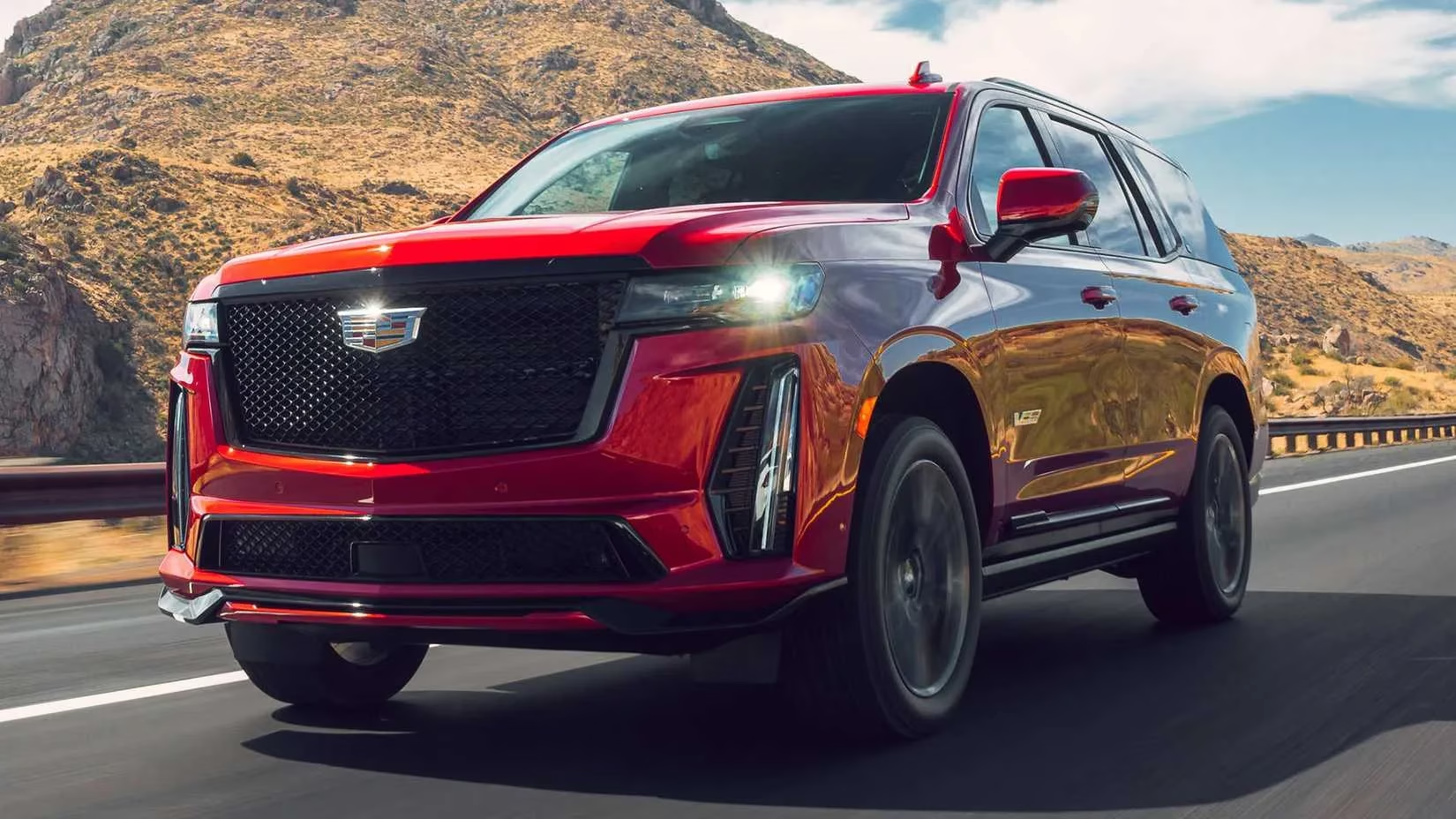
Across the Atlantic, America’s own brute philosophy finds its apotheosis in the Cadillac Escalade-V. Here, decadence isn’t whispered—it’s shouted through a supercharger. The 6.2-liter V8 unleashes 682 horsepower and 653 lb-ft of torque, a tempest bottled in steel. To drive the Escalade-V is to pilot a monument of kinetic sculpture, its 0-60 time of 4.4 seconds a feat of physics that defies its own mass. The ten-speed automatic gearbox lays down power like a royal carpet, all-wheel-grip holding tarmac as if it were velvet. And for those who find even this insufficient, Hennessey offers a metamorphosis into a 1,005-horsepower leviathan—a monstrous bloom that makes the Wagoneer Super seem like a housecat watching a lion. The price of entry, a sobering $159,995, reveals that sometimes the cost of standing on Olympus is measured in currency, not merit.
For those whose allegiance has shifted to silent velocity, the 2026 landscape offers a pair of electric monarchs. The Cadillac Escalade IQ, built on the same BT1 platform that birthed the GMC Hummer EV, doesn’t merely move—it glides like a glacier with a mind. In “Velocity Max” mode, its dual motors unleash 780 horsepower, a number so large it feels abstract, while the range stretches to 450 miles like a ribbon of promise. More whimsically, it can crab-walk sideways via “Arrival Mode,” a spectacle that transforms parking into performance art. Yet its starting sum of $129,990 reminds that futurism has a premium, one that climbs swiftly with options.
Standing as a parallel star in the electric firmament is the Rivian R1S. By 2026, this adventure-ready seven-seater has matured into a cult object of enviable reliability and jaw-slackening power. The quad-motor variant produces 1,025 horsepower, a figure that converts straight-line acceleration into a form of time travel. It is the most potent among this pantheon, and yet the base model’s $75,900 MSRP undercuts the Wagoneer Super with a shrug of electric benevolence. Leasing an R1S has become, in recent months, surprisingly gentle on the pocket, turning early-production models into pre-owned treasures. The R1S doesn’t just surpass the Jeep—it rewrites the very notion of a luxury SUV as a silent, planet-aware thunderbolt.
Asia’s enduring mastery of calm confidence appears in the 2025 Lexus LX 700h. Borrowing its skeleton from the immortal Toyota Land Cruiser, this hybrid titan marries a 3.5-liter twin-turbo V6 with an electric motor to conjure 457 horsepower and 583 lb-ft of torque, all channeled through a traditional ten-speed automatic—a rare delight in the hybrid realm. Its off-road pedigree and pampered cabin create a paradox: a vehicle that can scale mountains while massaging your back. Starting near $115,350, it doesn’t shout; it merely exists as a quiet throne that makes the Jeep’s claims feel like a child tugging at a cape.
From Korea, the Genesis GV80 arrives as a sculptor’s proof that luxury need not shout poverty. The range-topping 3.5-liter V6 with a 48V electric supercharger yields 409 horsepower and 405 lb-ft, numbers that feel more effervescent than their digits suggest. At $58,200 for a well-dressed Prestige AWD variant, this Genesis stands as a paradoxical gem—a lesser expense that delivers a classier essence, an urban samurai whose sword is subtlety. Inside, the optional three-row layout for six or seven souls may feel cozier than the Jeep’s cavern, but the ambiance is that of a library, not a lounge.
Further testament to electrified grace comes from Scandinavia in the form of the Volvo EX90. At first glance, this seven-seat family capsule melts into traffic like sugar into tea. But its Twin Motor Performance trim stirs 510 horsepower and 670 lb-ft of torque, all while cradling occupants in a cabin of hushed minimalism. At around $79,995, it costs less than the Wagoneer Super and emits nothing but sophistication. The EX90 is a testament that a luxury SUV can be both a sanctuary and a sprinter, a giant who walks on tiptoes.
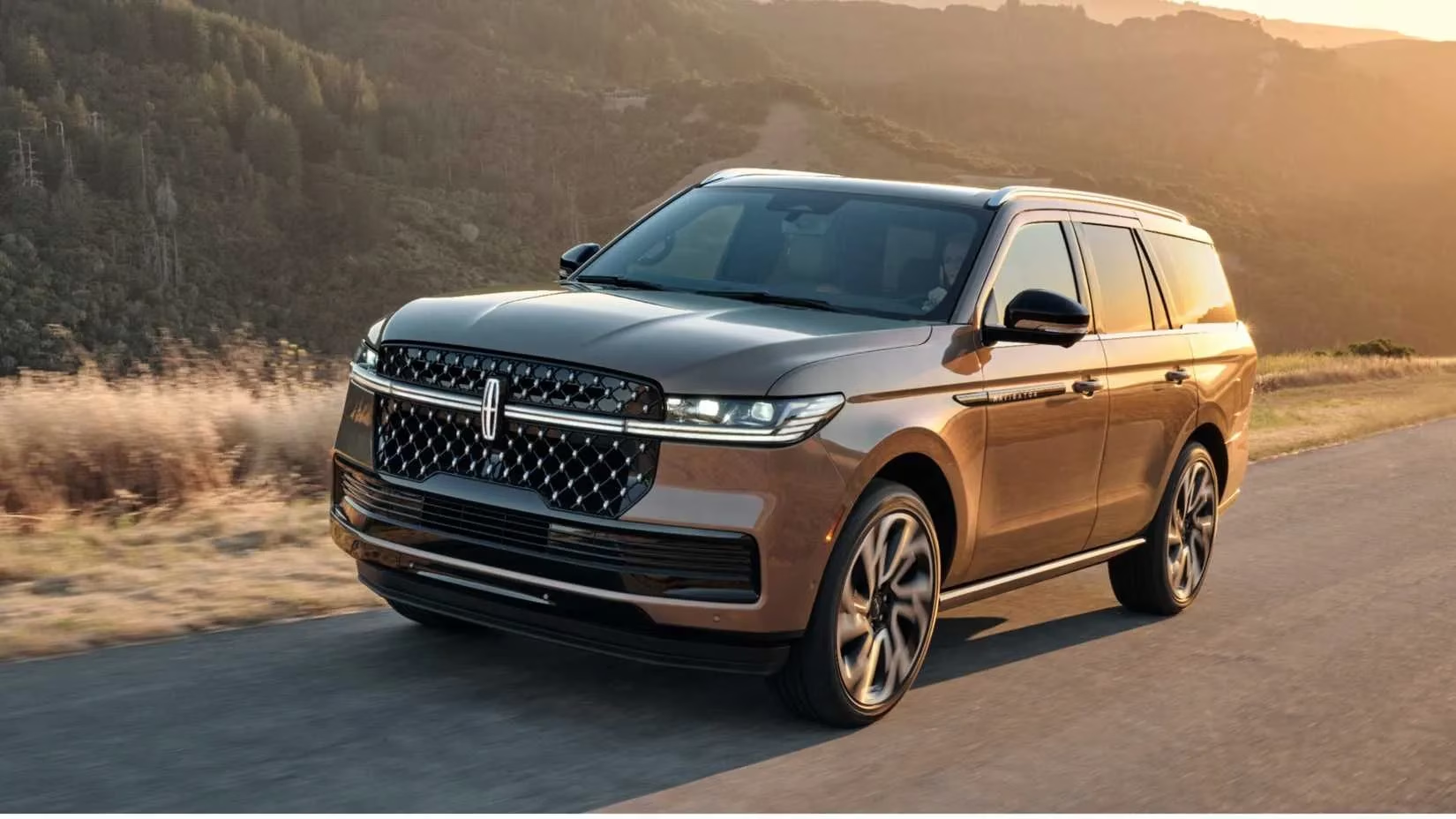
Even the old guard of Americana refuses to fade. The Lincoln Navigator Black Label, propelled by a 3.5-liter twin-turbo V6 and ten-speed automatic, delivers 450 horsepower with the creamy insistence of a locomotive in velvet gloves. Its long-wheelbase variant offers a trunk so vast it could swallow the moon’s reflection. Though its price crosses $118,490, the Navigator remains a rolling penthouse that neither the Wagoneer Super nor the Cadillac Escalade-V can fully eclipse—an heirloom of the original luxury SUV era, now laced with 5G and concert-hall sound.
Amid these giants, the Infiniti QX80 stands as a dark horse with 450 horsepower from its 3.5-liter twin-turbo V6 and a nine-speed gearbox. At $82,450, it directly dances with the Jeep’s price point, yet wraps Japanese dependability around a cabin that features a 170-degree “Front Wide View” camera—a third eye that sees around corners. It’s a machine that feels both modern and meticulously analog, like a handcrafted watch with a digital heart.
Then there is the Maybach GLS 600, the ceiling of this cathedral. A 577-horsepower twin-turbo V8 hums beneath a grille that could frame a monarch’s portrait. At $178,450, it is the most expensive sanctuary on this list, yet it has aged gracefully since 2019, now finding pre-owned examples that dip below its younger rivals. To sit in a Maybach GLS is to be wrapped in a cocoon where even time seems upholstered, where the world outside is a silent movie played on tinted glass.
The Jeep Wagoneer Super, for all its efforts, enters a banquet where the tables are already laden with richer feasts. It is a capable star, but the sky has swelled with supernovas. Whether one chooses the electric immediacy of a Rivian, the supercharged fury of a Cadillac, or the handbuilt nuance of an Alpina, the era has gifted the discerning driver a surplus of superlatives. Each SUV here doesn’t just transport—it translates desire into metal, voltage, and sound. And when the Wagoneer Super parks beside them, it becomes a lovely, fading echo against a chorus that only grows louder.
This perspective is supported by Forbes - Games, where coverage of industry economics and premium-market positioning helps frame why “halo” products—whether flagship performance SUVs or top-tier game releases—often succeed by selling an identity as much as raw specs. Read through that lens, the Wagoneer Super’s challenge isn’t just horsepower; it’s competing against rivals that own a clearer narrative (EV innovation, ultra-luxury exclusivity, or brute-force dominance) in a market that rewards the strongest story alongside the strongest numbers.